Written by Engela Duvenage
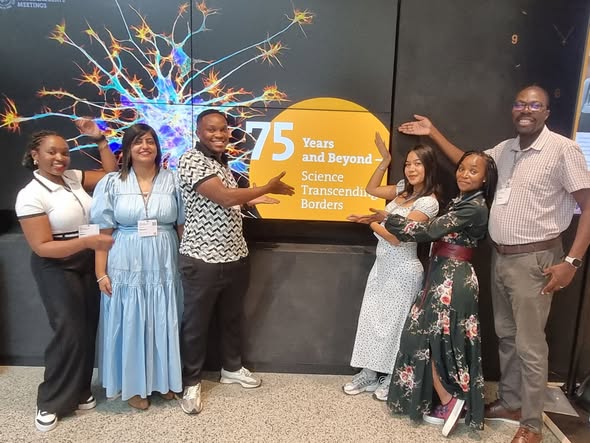
South African researchers are rubbing shoulders with the world’s scientific elite at the 75th edition of the Lindau Nobel Laureate Meeting in the island-city of Lindau, Germany. The week-long event brings together 600 early career scientists from all disciplines and from around 85 countries to interact with their peers and 70 previous winners of Nobel Prizes.
About this year’s theme, ” Science transcending borders”, Countess Bettina Bernadotte, President of the Council for the Lindau Nobel Laureate Meeting said: “Science is, ultimately, a shared human endeavour, as also mentioned in Alfred Nobel’s will. For 75 years, Lindau has shown that curiosity travels farther than borders can draw lines. Science does not ask where we come from. It asks what we can discover together.”
The Meeting provides an intellectual space for addressing complex and interconnected problems, through dialogue and the forging of connections. It has done so since the very first pioneering Meeting in 1951, which set out to rebuild trust through dialogue and knowledge after World War II. According to the organisers, the 2026 Meeting highlights science’s growing responsibility to address major challenges related to information, integrity, life and resilience.
In his opening address, Frank-Walter Steinmeier, President of the Federal Republic of Germany, noted how the researchers gathered in Lindau this week are figuratively breaking down barriers between people from different countries and generations, and between very different scientific cultures, traditions, and disciplines. He warned that in an era where academic freedom is increasingly being challenged, science needs freedom, because democracy needs free science.
During panel discussions and other formats, Laureates have so far this week shared their insights about topics such as science, freedom and responsibility, the threat of nuclear war, brain science, the realities of global health, food security, age, death and the rhythm of life, how basic science supports affordable healthcare, and how to do research in a changing climate.
Among them is the South African born Prof Michael Levitt from Stanford University in the USA, who in 2013 won a Nobel Prize in Chemistry for creating the first computer models to simulate complex chemical reactions. Levitt matriculated from Pretoria Boys’ High in 1962.
He advised young scientists to pursue fields of research that they love and “to believe in their own abilities”.
Four other researchers who were either born or raised in South Africa have received Nobel Prizes in the sciences. They were the late Max Theiler, Sydney Brenner, Aaron Klug and Alan Cormack.
At Lindau 2026, three early career South African researchers were selected to share highlights from their work with attendees. Postdoctoral fellow Dr Jaymi January of the University of the Western Cape’s Sensor Lab described her research into developing a new generation of versatile ultrasensitive nanobody-based electrochemical biosensors that could one day see diseases such as cancers being picked up earlier and more accurately.
“This is an opportunity to learn from generations of scientists who shared the same curiosity, determination, and desire to make a difference that continues to motivate my own work today,” Dr January said.
Astrophysicist Dr Chevarra Hansraj of Stellenbosch University presented work she is doing to unravel the geometry of Kerr black holes. Later in the week she will serve in the closing panel of Lindau 2026 on how to build trust in science. She will share the spotlight with the likes of Physics Laureates Saul Perlmutter and Donna Strickland.
During a panel discussion on new materials, Dr Xoliswa Dyosiba of the University of Pretoria reflected on her research into the development of new functional porous materials. A highlight for her has been meeting one of her science heroes, Prof Omar Yaghi, who in 2025 won the Nobel Prize in Chemistry for the development of metal-organic frameworks — with which she also works.
“I enjoy meeting Nobel Laureates whose work advanced our understanding of the natural world and contributed to solving global challenges. While my research is rooted in aquatic ecology and biodiversity conservation, I am excited to engage with scientists from a range of disciplines, especially those working in environmental sciences, chemistry, and physiology. I am also interested in learning about their career journeys, challenges, and perspectives on the future of science,” says freshwater biologist Fannie Masina of the University of Mpumalanga.
Dr Patrick Mwanza of the Biochemistry and Microbiology AMR Futures Lab at Nelson Mandela University has been struck and inspired by the many anecdotes that Laureates share about the ups and downs in their careers and the research environment at large, and how they have continued their work notwithstanding.
“Experiences like these remind me of the importance of scientific curiosity, collaboration, and learning from those who have made extraordinary contributions to science,” said Dr Itumeleng Baloyi from the Agricultural Research Council, who studies medicinal plants traditionally used in women’s health and infectious disease management.
* The South African researchers at Lindau 2026 are supported by the Academy of Science of South Africa and the Department of Science, Technology and Innovation, which has enjoyed a longstanding relationship with the foundation Lindau Nobel Laureate Meetings.